
The Booking You Never Knew You Lost: How AI Is Closing the Revenue Gap on Restaurant Phones
Callers who reach a ringing phone or a busy tone during service don’t wait, they call the next restaurant. Here’s what those missed bookings cost, and how an AI receptionist stops the leak.
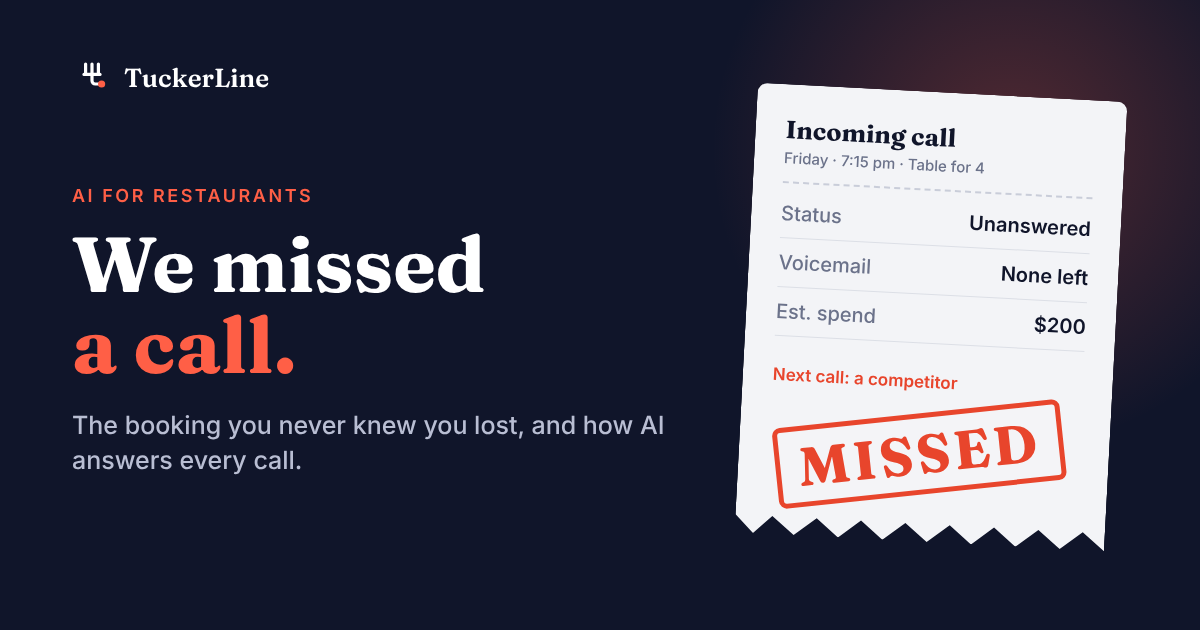
It's 7:15 on a Friday. The floor is full, the pass is flat out, and the front-of-house phone is ringing. Everyone who could answer it is carrying plates.
The caller was ready to book a table for four. Instead they got a ring-out, or a busy tone. They didn't try again. They called the next restaurant on the list, and that restaurant answered. You never saw that booking come in, and you'll never see it in a report. That is what makes it so expensive.
The leak you can't see
Restaurants track food cost, labour and no-shows closely. The phone rarely gets the same attention, even though it often sits at the exact point where a guest decides where to spend their money.
The published numbers are sobering, with some context first. They come from companies that sell phone-answering technology, and most are drawn from US venues, so treat them as indicators rather than gospel:
- Peak-hour misses: A 2025 analysis of more than a million restaurant calls reported that venues miss around 33% of incoming calls during peak service, and that 68% of all calls arrive during the lunch and dinner rushes.
- The phone still matters: The same analysis found that 58% of reservations still start with a phone call rather than an app or website.
- A wide range: Other vendor reports and case studies quote anywhere from roughly 23% to over 40% of calls missed at individual venues, depending on the venue and how it was measured.
The range is wide, and that's the point. Your own number is somewhere in it. The honest way to find out is to count how many calls your venue gets in a busy week, and how many go unanswered.
Why the phone fails when it matters most
It isn't a staffing failure. It's a timing problem. The moments when guests are most likely to call, just before and during service, are the same moments your team is least able to pick up. You can't fix that by asking people to try harder. A host who answers every call during a full dinner service is a host who isn't seating the people standing in front of them.
And callers don't wait. Most won't leave a voicemail. They move on.
What "always answered" actually means
An AI receptionist doesn't replace your team. It covers the gap between a ringing phone and a free pair of hands. Done properly, it does more than pick up. For a booking, the useful version:
- Answers every call, every time: Overnight, on public holidays, and when every line would otherwise be busy. There's no queue and no busy tone, because it can take many calls at once.
- Checks availability before promising anything: It looks at real tables, real party sizes and real sitting times, rather than taking a name and hoping.
- Creates the booking: Name, number, party size, date and time are captured and recorded, with a reference the guest can quote later.
- Confirms it: The guest gets an SMS, and your team sees the booking land in the dashboard without anyone typing it in.
- Hands off when it should: If a caller wants the manager, or something doesn't fit, the call can be transferred to a staff member who's on duty, or a message is taken.
The same call also handles the questions that eat your host's time: opening hours, today's specials, allergens, takeaway orders, and the "I think I left my jacket there last night" call.
Putting a number on it
You don't need a vendor's statistics to see what this is worth. Use your own: missed booking calls per week × average spend per booking × 52.
As an illustration, three missed bookings a week from tables of four, at $50 a head, comes to $200 a booking, or about $31,000 a year. That's an example, not a promise. Your figures will differ, and plenty of venues will be higher or lower. It's still a useful exercise, because most owners have never worked it out.
Then compare it against what you'd pay to stop it. Some AI phone services charge a modest monthly fee, others charge only for the minutes used. If a single recovered booking a week covers the cost, the arithmetic gets easy quickly.
What to ask before you choose one
Not every phone AI is the same, and a poor one can cost you goodwill rather than earn bookings. Before committing, ask:
- Can I hear it? Ring the demo line yourself. Better still, ask someone who doesn't know you're testing it to do the same.
- Does it check real availability? Or does it just take messages and leave your team to sort them out?
- What happens when it can't help? Is there a clean handoff to a person?
- Does it tell callers it's a virtual assistant? Honesty at the start of the call builds trust, and it's the right thing to do.
- Who supports it? When something needs tuning, are you speaking to the engineers who built it, or a ticket queue overseas?
- Am I locked in? A small venue should be able to try it without signing a long contract.
The point isn't the technology
Hospitality has always been about making people feel looked after. A guest who gets a warm, accurate answer at 7:15 on a Friday, a confirmed booking and a text to prove it, has already had a good first experience with your restaurant before they've walked in. The ones who don't get that answer have had a different first experience, with someone else.
Tuckerline is an AI phone receptionist for restaurants and cafés, built and supported by experienced voice engineers in Australia, and a LevelUP Solutions product. Call our demo restaurant, Coco Jumbo, any time on (07) 5227 8165 and talk to Lucia, or visit tuckerline.com.au.
These figures come from companies that sell phone-answering technology and mostly reflect US restaurants, so they are indicators rather than Australian benchmarks. The $31,000 example is an illustration, not a forecast.
LevelUP Solutions is committed to helping businesses answer every call. Contact us today to learn more about our AI agents.